Home Workout Gear Actually Worth Buying
Disclosure: Some links in this post are affiliate links. If you buy through them, Fit After 45 Women may earn a small commission at no extra cost to you. Learn more.
Search “home workout gear for women over 50” and you will drown in gadgets: vibrating belts, thigh toners, posture gizmos reviewed by people who used them twice. Here is the honest version: for a midlife home setup, you need exactly five things. For each one, here is what to look for, what to skip, rough prices, and who it suits best.
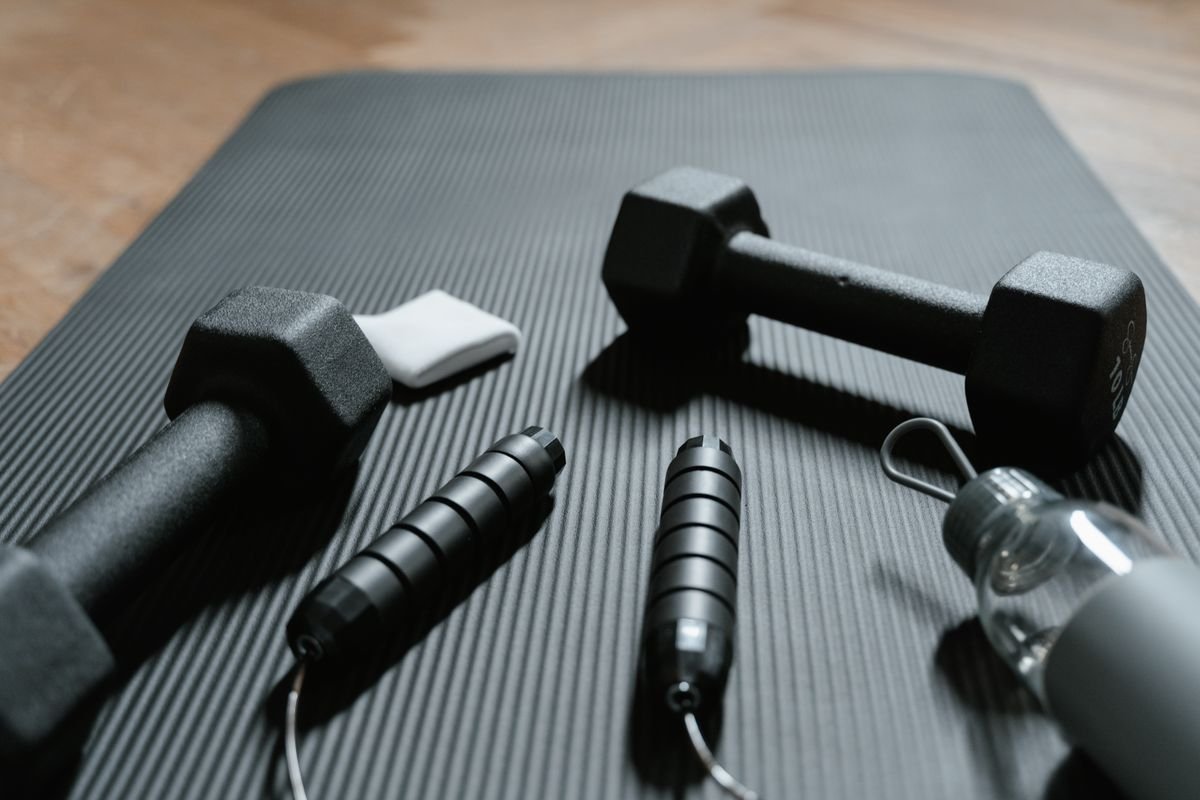
1. Adjustable or light dumbbells
Why it matters: Strength training is the most important exercise habit after 45, and dumbbells are the most versatile way to do it at home: pressing, rowing, squats, lunges, and core work. A set of light dumbbells in 3, 5, and 8 pounds covers almost everything a beginner needs, and adjustable dumbbells that go from about 5 to 25 pounds each handle progression for a long time.
What to look for: Comfortable grips, flat or hexagonal sides so they do not roll away, and a weight you can control. For wrist or grip issues, look for contoured or soft-grip handles.
What to skip: Ultra-heavy pairs you cannot lift safely, novelty shapes, and anything under 2 pounds marketed as toning weights.
Rough price: Fixed sets run about $25 to $60 for a starter range; a good adjustable pair runs about $80 to $200.
Best for: Anyone ready to start strength training at home, which should be nearly everyone. (Related: Strength Training for Women Over 45: A Beginner Plan That Respects Your Joints)
2. Resistance bands set
Why it matters: Bands are the joint-friendly complement to dumbbells: great for warm-ups, glute and hip work, and travel, and gentler on achy shoulders and knees than free weights. A full set of loop and tube bands with varying resistance levels and a door anchor gives you dozens of exercise options for very little money and almost no storage space.
What to look for: At least 4 or 5 resistance levels, sturdy handles, a door anchor, and latex loops that last. Check reviews for durability complaints.
What to skip: Single bands with no handles, cheap sets with thin handles that dig into your palms, and “booty bands” sold individually at inflated prices.
Rough price: About $20 to $40 for a complete quality set.
Best for: Travelers, apartment dwellers, anyone with joint pain, and as a warm-up tool alongside dumbbells.
3. Yoga mat
Why it matters: You need a stable, cushioned surface for floor work: core, stretching, mobility, yoga. A thick, non-slip mat (around 6mm or more) makes floor time comfortable, which means you will actually do it.
What to look for: At least 6mm thick, non-slip top and bottom, easy to clean, and long enough for your full body. TPE or natural rubber are solid picks.
What to skip: Ultra-thin “travel” mats as your only mat, mats that smell strongly of chemicals when unrolled, and anything so narrow your hands slip off the edges.
Rough price: About $25 to $60.
Best for: Anyone doing floor work, stretching, or following along with mobility and core routines.
4. Walking pad
Why it matters: Walking is the most underrated midlife exercise, and the biggest obstacle is usually logistics: weather, darkness, schedules. A walking pad (a slim treadmill without tall handles) tucks under a desk or against a wall so you can walk while the day happens around you. A compact, folding walking pad with a speed range up to about 4 mph is one of the highest-value purchases on this list if you struggle to get steps in.
What to look for: A quiet motor, a belt long enough for your stride, simple remote or app control, and a weight capacity comfortably above your weight. Folding storage is a must for most homes.
What to skip: Full-size treadmills if you are short on space, pads that require app subscriptions for basic use, and ultra-cheap models with wobbly belts.
Rough price: About $150 to $400.
Best for: Anyone whose step count is the bottleneck. It practically pays for itself in consistency. (Related: Walking for Menopause Weight Loss: The 8,000-Step Reset)
5. Foam roller
Why it matters: Recovery becomes non-negotiable after 45. A foam roller works out tight quads, calves, and upper back from desk jobs and commutes. Five minutes of rolling after a workout makes the next one much more pleasant. A standard 18-inch high-density foam roller is all you need: no motors, no apps, no vibrating attachments.
What to look for: High-density foam (cheap soft ones collapse fast), 18 inches for general use, and a smooth or gently textured surface rather than aggressive knobs.
What to skip: Motorized or vibrating rollers, tiny travel rollers as your only roller, and anything with a pain-is-gain marketing angle.
Rough price: About $15 to $30.
Best for: Anyone with tight hips, calves, or upper back, which is nearly everyone sitting at a desk.
What home workout gear should you skip?
Gear marketed hard to midlife women that is not worth the money for most beginners:
- Gimmicky ab gadgets: Ab wheels, electric ab belts, toning machines for one tiny muscle group. Core strength comes from compound movements and consistency.
- Expensive all-in-one machines: $1,000-plus systems suit advanced lifters with space. For beginners, dumbbells and bands deliver 90 percent of the results for a fraction of the cost.
- Smart mirrors and subscription equipment: The monthly fee adds up, and the workouts are not meaningfully better than free routines.
- Balance boards and posture gadgets: Occasional fun, rarely used after month two.
What should a starter kit include at each budget?
$50 starter kit: A resistance bands set ($25) plus a foam roller ($20). That is a complete stretching, mobility, and light-strength setup. Add bodyweight exercises and walking outside and you have a real program.
$150 starter kit: Bands ($30), a yoga mat ($35), a foam roller ($20), and a light dumbbell set ($60). This is the sweet spot for most women: everything needed for a full home strength and mobility routine, no gym required.
$300 starter kit: Everything in the $150 kit plus a budget walking pad ($150 to $200 at the low end). This is the setup that removes the last excuse: strength, mobility, and steps, all at home, in any weather.
Buy what fits your budget and space. A $30 band set you reach for beats a $1,500 machine you do not. Build the habit first, and only add equipment when your routine calls for it.
Frequently asked questions
What home workout equipment do women over 45 really need?
Five things cover almost everything: light or adjustable dumbbells, a resistance band set, a thick yoga mat, a foam roller, and, if steps are hard to fit in, a walking pad.
What weight dumbbells should I buy as a beginner?
A set of 3, 5, and 8 pounds covers most beginner exercises. Adjustable dumbbells that go from about 5 to 25 pounds each handle progression for a long time.
Is a walking pad worth the money?
It is one of the best purchases on the list if your daily step count is the bottleneck. Expect to pay about $150 to $400.
Can I get a good workout with only resistance bands?
Yes, especially as a beginner. Bands plus bodyweight exercises and outdoor walking make a complete starter program for about $50.
Sources and further reading
- Adult Activity: An Overview, Centers for Disease Control and Prevention
A quick note: this is general wellness information, not medical advice. If you have a health condition, take medication, or are starting a new exercise or eating routine, check in with your doctor first.