Strength Training for Women Over 45: A Beginner Plan That Respects Your Joints
If you have never lifted a weight, or your knees complain about stairs, strength training might sound like the last thing you should try. In fact, it is one of the first things worth trying after 45. Muscle keeps you strong, steady, and metabolically healthy, and your body loses it faster in midlife unless you give it a reason to stay.
Why does muscle matter more after 45?
Starting in your 40s, most adults lose a small percentage of muscle every year if they do nothing to maintain it, and the loss tends to accelerate around menopause. Less muscle means less strength for everyday tasks, a slightly lower resting energy burn, and a higher risk of falls later on.
The good news is that muscle responds to strength training at every age. You will not accidentally get bulky; that takes years of deliberate heavy training plus a calorie surplus. What you will get is stronger, steadier, and harder to injure, with better bone density as a bonus. (Related: Bone Health After 45: The Exercises That Protect You)
What equipment do you need?
Pick one of these, not all of them:
- Light dumbbells. Start with 5 to 8 pounds each; many women reach 10 or 12 within weeks.
- Resistance bands. Cheap, joint-friendly, and travel well. Often kinder than dumbbells for sensitive shoulders or wrists.
- A sturdy chair for balance support, and a mat or carpeted area for floor work.
Allow 30 to 40 minutes per session, including warm-up and cool-down.
Warm-Up (5 Minutes, Every Session)
Never skip this. It is the cheapest injury insurance you have.
- March in place, 1 minute, swinging your arms.
- Arm circles, 30 seconds each direction, growing the circle.
- Hip circles, 30 seconds each direction, hands on hips.
- Leg swings, 10 per leg, holding the chair.
- Bodyweight squats, 10 slow reps, comfortable depth only.
What does the 3-day weekly routine look like?
Train three non-consecutive days per week, for example Monday, Wednesday, and Friday. All three sessions use the same six exercises below. Repeating the same movements as a beginner builds good form fast. Rest 60 to 90 seconds between sets.
1. Chair-Assisted Squat
Stand in front of a sturdy chair, feet hip-width apart, toes slightly out. Push your hips back, lower until you lightly touch the seat, then press through your heels to stand. Keep your chest up and knees over your toes.
Joint cue: Limit your depth if your knees complain. A shallow squat done well beats a deep squat done badly.
Sets and reps: 2 sets of 10 to 12
2. Wall Push-Up
Stand an arm’s length from a wall, hands at shoulder height and width. Bend your elbows to bring your chest toward the wall, then press back. When these feel easy, move to a kitchen counter for more challenge.
Joint cue: Keep your body in a straight line from head to heels. Do not let your lower back sag or shoulders creep toward your ears.
Sets and reps: 2 sets of 8 to 12
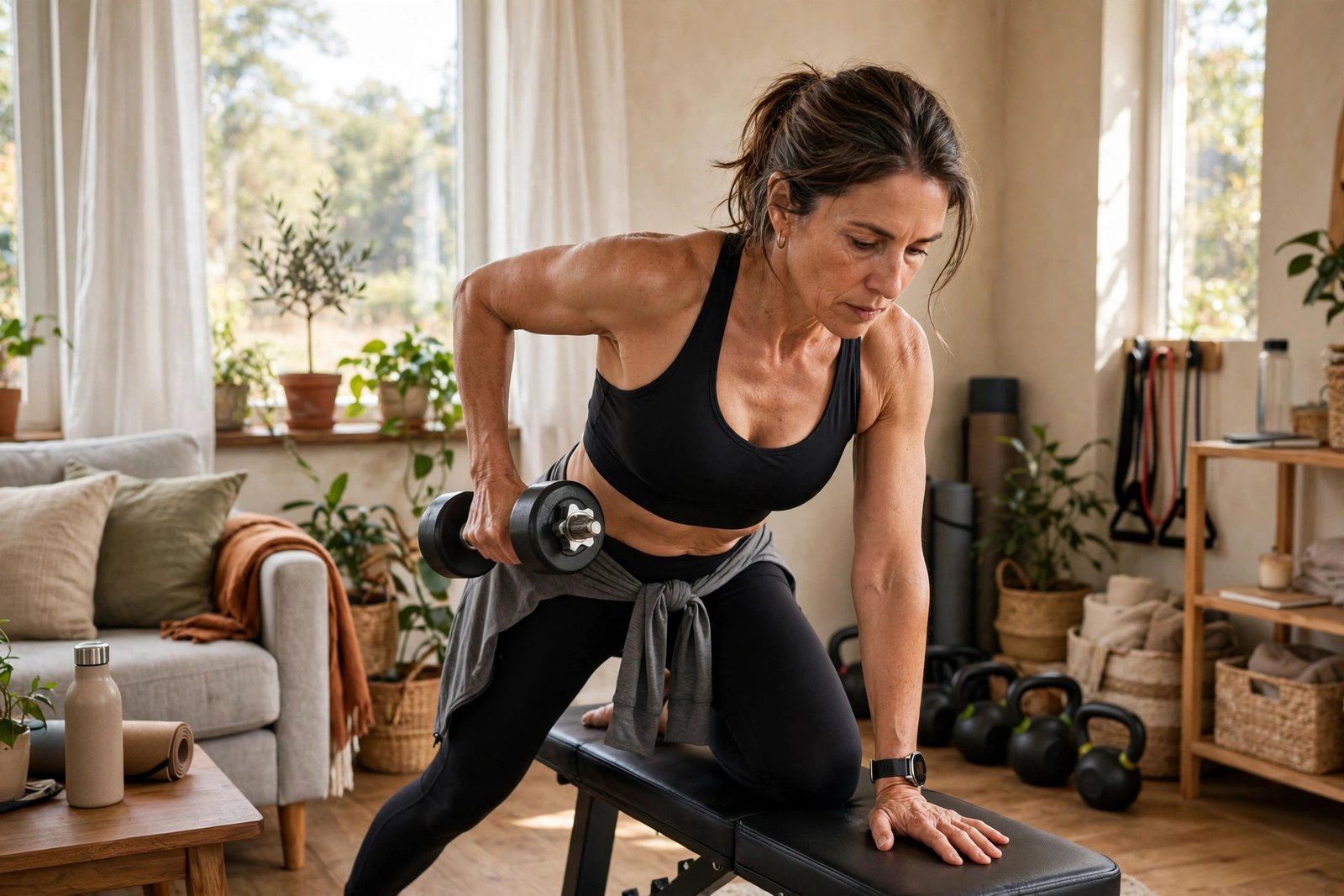
3. Bent-Over Row
Hinge forward at the hips with a flat back, a dumbbell in each hand (or standing on a band). Pull toward your lower ribs, squeezing your shoulder blades together, then lower with control.
Joint cue: Pull your elbows behind you rather than lifting the weights up. If your lower back rounds, raise your torso a little.
Sets and reps: 2 sets of 10 to 12
4. Glute Bridge
Lie on your back, knees bent, feet flat. Press through your heels to lift your hips until your body forms a straight line from shoulders to knees. Squeeze your glutes for two counts at the top, then lower slowly.
Joint cue: Do not overarch your lower back. If you feel this in your back instead of your glutes, lower your hips slightly.
Sets and reps: 2 sets of 12 to 15
5. Standing Overhead Press
Hold light dumbbells at shoulder height, palms forward. Press up until arms are nearly straight, then lower slowly. Start very light; shoulders are sensitive.
Joint cue: Tighten your core and keep your ribs down. If you feel pinching, stop before full overhead.
Sets and reps: 2 sets of 8 to 10
6. Dead Bug
Lie on your back, arms toward the ceiling, knees bent at 90 degrees over your hips. Slowly lower your right arm overhead while extending your left leg toward the floor, keeping your lower back pressed into the mat. Return and switch sides.
Joint cue: The moment your lower back arches off the floor, you have gone too far. Shorten the range.
Sets and reps: 2 sets of 6 per side
Cool-Down (5 Minutes)
Hold each stretch 20 to 30 seconds per side, breathing slowly, and never force a stretch into sharp pain: standing quad stretch (hold the chair), calf stretch at the wall, chest opener in a doorway, figure-four hip stretch, gentle neck rolls.
How do you progress from week 1 to week 8?
- Weeks 1 and 2: Learn the movements with the lightest weights. Two sets each. Mild soreness for a day or two is normal; sharp pain is not.
- Weeks 3 and 4: Add a third set to each exercise. Keep the rest days; they matter as much as training days.
- Weeks 5 and 6: Go slightly heavier, use a stronger band, or move push-ups to the counter. Drop to two sets for the first week at the new level, then build to three.
- Weeks 7 and 8: Add reps before adding weight. When you can finish all sets at the top of the rep range with good form, move up a small increment. If you cannot finish your reps with good form, the weight is too heavy; if you could do five more, it is time to go up.
Which form cues protect your joints?
- Knees: Track over your toes in squats. Never let them cave inward.
- Shoulders: Keep them down and back, away from your ears, especially when pressing.
- Back: Maintain a neutral spine. Brace your core gently, like someone is about to tap your stomach.
- Neck: Keep it long and neutral. Do not crane forward during floor exercises.
- Wrists: Keep them straight, not bent backward, when holding dumbbells.
If an exercise consistently hurts a joint even after adjusting form, swap it out. There is always an alternative, and pain is information, not a badge of honor.
Start where you are and progress patiently. Two or three short sessions a week, done consistently, will change what your body can do. (Related: The Best Low-Impact Workouts for Achy Joints)
Frequently asked questions
How often should women over 45 strength train?
The CDC recommends muscle-strengthening activity at least 2 days a week for adults. This plan uses 3 non-consecutive days, such as Monday, Wednesday, and Friday, with rest days in between.
What weight dumbbells should a beginner over 45 use?
Start with 5 to 8 pounds each. When you can finish every set at the top of the rep range with good form, move up a small increment.
Will strength training make me bulky?
No. Getting bulky takes years of deliberate heavy training plus eating in a calorie surplus. What you will get is stronger, steadier, and harder to injure.
Can I strength train with knee pain?
Usually, with adjustments. Limit squat depth, use a chair for support, and swap out any exercise that keeps hurting. Sharp pain is a signal to stop and check with a professional.
How long until I notice I am stronger?
Many women notice they are lifting more within a few weeks. The plan builds over 8 weeks, adding sets first, then reps, then weight.
Sources and further reading
- Adult Activity: An Overview, Centers for Disease Control and Prevention
- Exercise and Safe Movement, Bone Health and Osteoporosis Foundation
A quick note: this is general wellness information, not medical advice. If you have a health condition, take medication, or are starting a new exercise or eating routine, check in with your doctor first.